Exit Planning
Your Business Isn't Always Worth What You Need to Retire

The difference between what you need and what a buyer will pay could cost you millions—unless you prepare.
This may be one of the hardest conversations I have with business owners.
You've spent 20, 30, or even 40 years building your business. You've sacrificed time, invested your savings, taken risks, and worked tirelessly to create something valuable.
Now you're ready to retire, and you've calculated exactly how much money you need to enjoy the next chapter of your life.
But here's the uncomfortable truth: what you NEED from the sale of your business and what the MARKET is willing to PAY could be two completely different numbers.
The $1.2 Million Reality Check
The Seller's Number:
"I need $4 million to retire comfortably, pay off my obligations, and leave something for my family."
The Buyer's Number:
"Based on normalized EBITDA, operational risk, comparable transactions, and the company's ability to service acquisition debt, I can justify $2.8 million."
That's a $1.2 million gap.
And unfortunately, buyers don't determine value based on your retirement goals, emotional investment, or years of sacrifice.
They determine value based on financial performance, future earning potential, operational stability, risk, and return on investment.
So, How Do We Bridge That Gap?
As an M&A advisor, my role isn't simply to put a price tag on your business and find a buyer. It's to identify opportunities to strengthen your company's value, position it strategically, and structure a transaction that supports your financial goals.
Here are 10 strategies that can help:
-
EBITDA Improvement — Increase profitability by identifying opportunities to grow revenue, improve margins, eliminate inefficiencies, and strengthen sustainable cash flow.
-
Add-Backs — Identify legitimate, documented non-recurring, discretionary, or owner-specific expenses that a buyer may accept when calculating adjusted earnings.
-
Financial Normalization — Present a clear, accurate picture of the company's sustainable financial performance by adjusting for unusual transactions and expenses that won't continue under new ownership.
-
Seller Financing — Consider financing a portion of the purchase price to expand the buyer pool, facilitate the transaction, and potentially negotiate more favorable terms—while managing repayment risk.
-
Earnouts — Bridge valuation disagreements by allowing the seller to receive additional compensation if the business achieves clearly defined performance milestones after closing.
-
Retained Equity — Maintain a minority ownership interest after the sale, allowing you to receive liquidity today while potentially participating in future business growth and a second exit.
-
Real Estate — Evaluate whether company-owned real estate should be sold with the business, sold separately, or retained to generate rental income and support long-term wealth.
-
Working Capital — Establish an appropriate working capital target to protect transaction value, avoid unexpected closing adjustments, and ensure the buyer receives sufficient operating liquidity.
-
Strategic Buyers — Target buyers who may recognize additional value through synergies, geographic expansion, customer relationships, cost savings, or complementary services.
-
Pre-Sale Preparation — Begin strengthening your financials, systems, management team, and operational structure well before going to market to improve buyer confidence, reduce perceived risk, and support a stronger valuation.
The Most Powerful Strategy? PRE-SALE PREPARATION.
Here's what I want every business owner to understand:
The best time to increase the value of your business is BEFORE you decide to sell it—not after a buyer tells you what it's worth.
Too many owners wait until they're exhausted, burned out, facing health concerns, or simply ready to walk away before thinking seriously about an exit.
By then, they may have limited time to address the very issues that are reducing their company's value.
Imagine if you started preparing 12 to 24 months before your desired exit.
You could:
-
Strengthen your financial performance: Improve profitability, clean up financial statements, document add-backs, and establish a defensible earnings history.
-
Reduce owner dependency: Develop a capable management team so the business can operate successfully without your daily involvement.
-
Document your operations: Create standard operating procedures (SOPs), strengthen internal controls, and establish repeatable processes.
-
Address buyer red flags: Resolve customer concentration, employee retention, compliance, contract, and other operational risks before due diligence.
-
Build recurring and predictable revenue: Strengthen customer retention, diversify revenue streams, and demonstrate consistent future earning potential.
-
Develop your personal exit strategy: Coordinate with your financial, tax, and legal advisors to understand how much you actually need to NET from the transaction—not just the gross selling price.
Small Improvements Can Create Significant Value
Let's look at a hypothetical example.
Suppose your business currently generates $700,000 in adjusted EBITDA, and the market supports a 4× multiple.
Estimated Enterprise Value: $2.8 Million
Now imagine that, through strategic pre-sale preparation, you increase sustainable adjusted EBITDA to $850,000 and reduce operational risks enough to support a 4.5× multiple.
Potential Enterprise Value: $3.825 Million
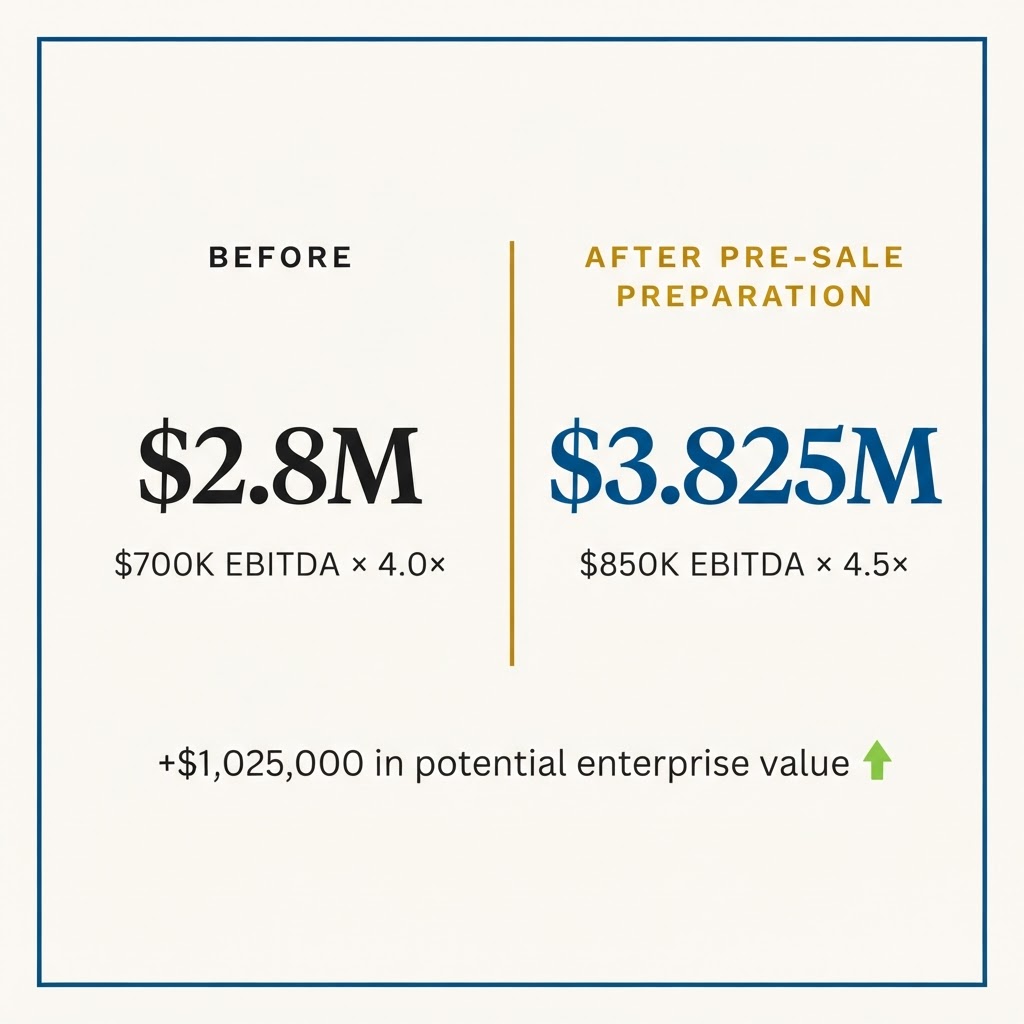
That's an increase of more than $1 million in potential business value—without relying solely on finding a buyer willing to overpay.
Of course, valuation multiples vary by industry, business size, market conditions, and risk. These figures are illustrative, not guaranteed outcomes.
Your Exit Should Be a Strategy, Not an Emergency.
Selling your business will likely be one of the most significant financial transactions of your lifetime.
And for many business owners, the company represents the largest portion of their personal wealth.
Why leave the outcome of that transaction to chance?
At Legacy Team Associates™, we help business owners prepare for their most important financial transition through our EXIT READY advisory approach.
We work with you to identify what's driving your company's value, uncover what's holding it back, and develop a strategic roadmap to position your business for a successful exit.
Whether you're planning to sell in 12 months, two years, or simply want to understand what your business is worth today, the time to start preparing is NOW.
Remember: the goal isn't just to SELL your business. It's to maximize what you KEEP, protect what you've BUILT, and create the LEGACY you deserve.
Ready to Find Out If Your Business Is EXIT READY?
Don't wait until a buyer tells you your business is worth less than you expected.
Let's identify the opportunities to strengthen your valuation, reduce risk, and prepare for the exit you deserve.
Ready to Plan Your Exit?
Schedule a complimentary consultation with Legacy Team Associates and take the first step toward a successful business exit.
Book a CallComments (0)
Be the first to comment.
Related Articles

What Buyers Are REALLY Looking for in 2026 — And It Isn't Just Revenue
A $5 million business sounds impressive — until a buyer asks how much of that profit survives without you. Here are the 7 characteristics buyers pay premiums for in 2026, backed by real acquisition data.

5 Signs Your Business Is Ready for an Exit
How do you know when the time is right to sell? Here are five clear indicators that your business is exit-ready and positioned for maximum value.

Preparing Your Financials for Sale: A Checklist
Messy financials kill deals. Use this checklist to get your books buyer-ready before you go to market.

